

The Big Picture
If you’ve ever taught a large online course, you know the drill: online discussion boards become your go-to tool for student engagement. They’re scalable, easy to set up, and research tells us they work. But let’s be honest—they also come with their share of headaches: low participation, uneven contributions, or students going through the motions just to check a box.
So, is there a better or at least complementary way to drive deeper engagement and learning?
I explored this question with my colleague, David Joyner, in a recent large-scale study, comparing the effects of peer assessment and online discussion on online students’ learning. We analyzed data from 1,451 students in the same online graduate course over five years (Spring 2020 to Fall 2024). What we discovered has really shed light on how we think about strategies for student engagement.
What Did We Learn?
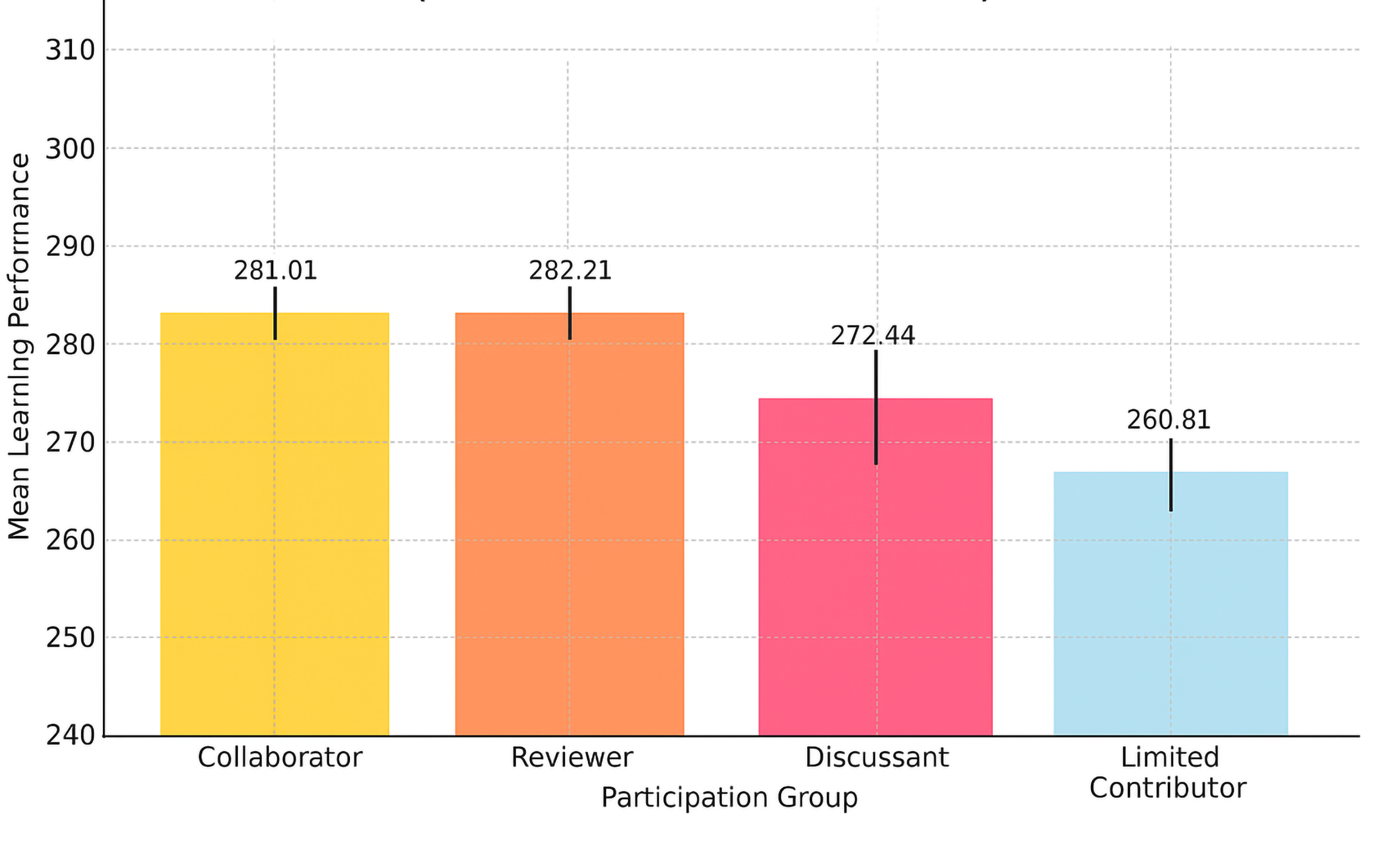
Figure 1: Mean learning performance scores by student participation group.
The figure breaks down student learning performance into four distinct levels of engagement. The data reveals a clear “step-up” effect:
-
Top Tier (Collaborators & Reviewers): Students who actively provided feedback to peers achieved the highest learning outcomes.
-
Middle Tier (Discussants): Students who primarily stuck to discussion boards performed well, but significantly lower than those who engaged in peer review.
-
Lower Tier (Limited Contributors): Students with minimal engagement in either activity saw the lowest performance scores.
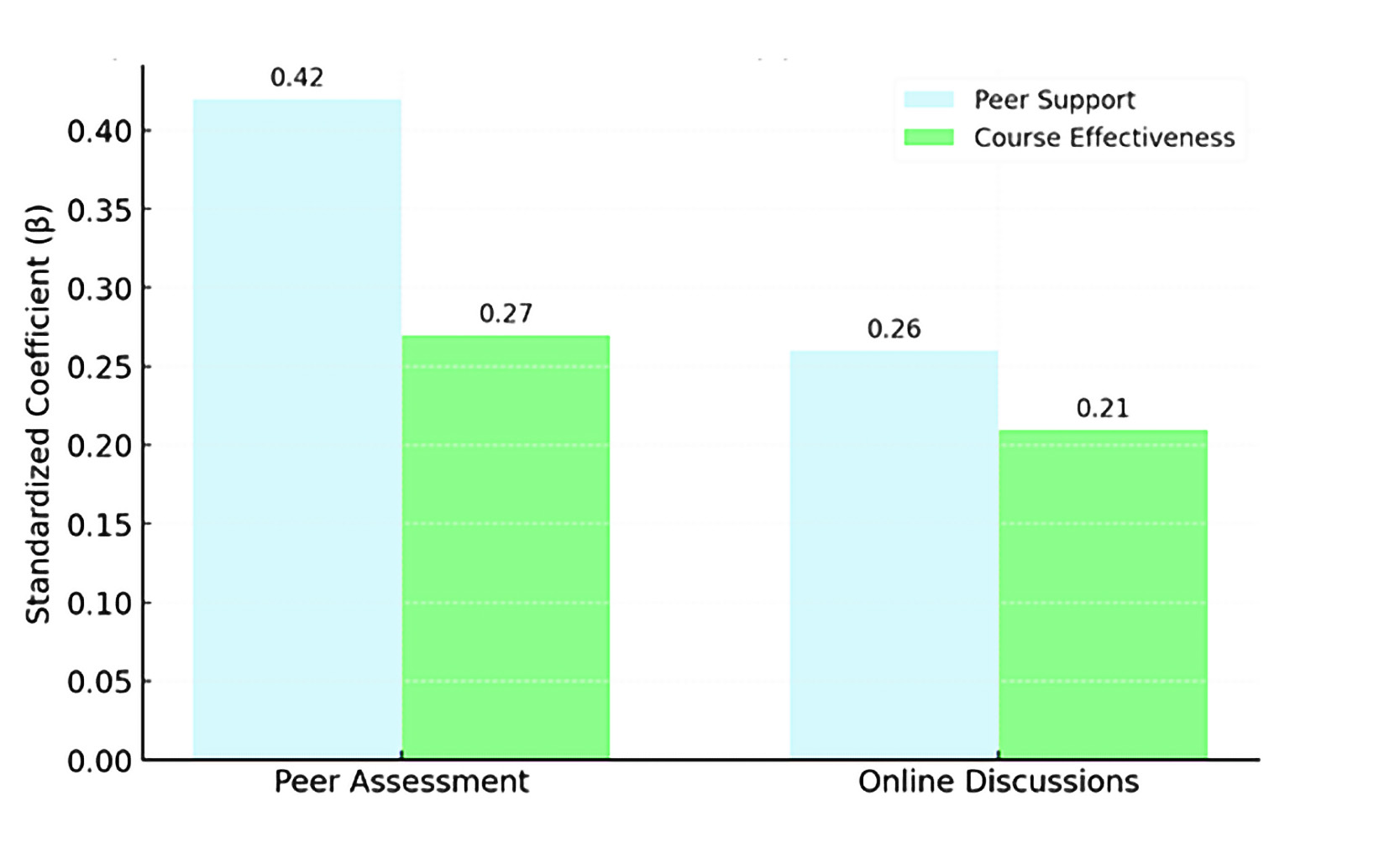
Figure 2: The Hidden Value of Peer Assessment.
This figure measures student sentiment. Specifically, how much support they felt and how highly they rated the course.
We used a statistical measure called the “Standardized Coefficient (𝛽) to compare the impact of different activities. In plain English, this chart shows that peer assessment is a much stronger predictor of student satisfaction than discussion boards.
Even though discussion boards are often used to build community, the data suggests that the act of giving and receiving structured feedback actually does a better job of making students feel supported by their peers.
What Does This Mean for Teaching?
Online discussions are like the warm-up, and peer assessment is the workout.
When you combine them strategically, you are creating a learning rhythm
that helps students move from participation to transformation.
Think of it this way: online discussions are like the warm-up—they loosen things up, get students talking, and build comfort. Peer assessment is the workout—it stretches their thinking, builds intellectual stamina, and strengthens their ability to evaluate and reflect. You need both to build learning muscles that last.
When you combine them strategically, you’re creating a learning rhythm: online discussions offer easy entry points, while peer assessment provides structured, reflective engagement. Together, they help students move from participation to transformation.
But Here Are the Challenges…
Anyone who’s implemented peer assessment knows it’s not exactly plug-and-play. You’ve got to:
- Design clear rubrics (which takes time to create and refine)
- Train students to give quality feedback (not just “Great job!”)
- Manage the logistics (who reviews whom? when? how many?)
- Deal with fairness concerns (Is this grade reliable? Is there bias?)
Enter AI: A Game-Changer?
 This is where things get exciting (and a bit futuristic). What if AI could tackle those persistent pain points? Not replace the instructor or eliminate the human element, but handle the heavy lifting so we can focus on what matters most: student learning.
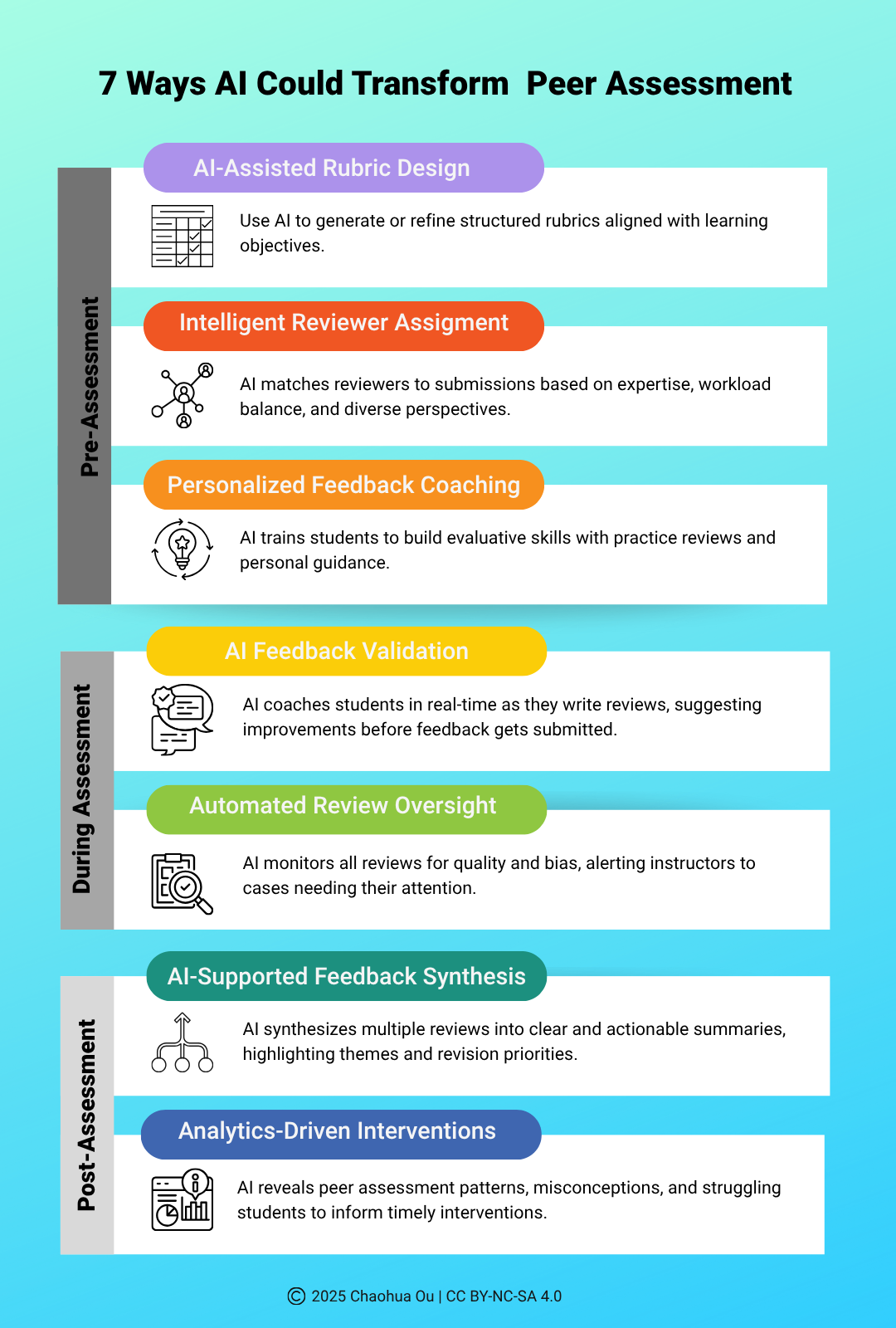
Based on my research and emerging work in this space, I’ve been developing a framework for designing AI-Augmented Peer Assessment. This framework includes seven elements organized across three stages of the peer assessment process. It aims at leveraging AI to streamline logistics, enhance quality feedback, ensure fairness, and ultimately, create a richer and more engaging learning experience for all learners.
The Framework: 7 Ways AI Could Transform Peer Assessment
The Reality Check
Now, before you get too excited (or worried), let me be clear:
Some of these elements exist in various tools today. Others are still in the research phase. Building a comprehensive platform that does all seven seamlessly? That’s going to take serious development work, cross-disciplinary collaboration, and significant investment.
- How do we protect student privacy while using their data to improve learning?
- How do we ensure AI doesn’t perpetuate or amplify bias?
- How do we maintain transparency so students and instructors understand how AI is making decisions?
- Where’s the line between helpful automation and over-reliance on algorithms?
Want to Dive Deeper?
If you are interested in the research behind this framework, here are some excellent resources:
- Darvishi, A., Khosravi, H., Sadiq, S., & Gašević, D. (2022). Incorporating AI and learning analytics to build trustworthy peer assessment systems. British Journal of Educational Technology, 53(4), 844–875. https://doi.org/10.1111/bjet.13233
- Ou, C. (2024). Engaging students with peer assessment. In C. Ou. Designing Socially Dynamic Digital Learning (pp. 98-112). Routledge. https://doi.org/10.4324/9781003368076
- Ou, C., & Joyner, D.A. (2025). Assess or discuss: Comparing peer assessment and online discussion for enhancing learning at scale.
L@S ’25: Proceedings of the Twelfth ACM Conference on Learning @ Scale, Pages 222 – 226. https://doi.org/10.1145/3698205.3733927
- Ou, C., Thajchayapong, P., & Joyner, D.A. (2024). Open, collaborative, and AI-augmented peer assessment: Student participation, performance, and perceptions. L@S ’24: Proceedings of the Eleventh ACM Conference on Learning @ Scale, Pages 496 – 500. https://doi.org/10.1145/3657604.366470
- Sichterman, B., Noroozi, O., Boetje, J., van Ginkel, S., Khosravi, H., & Versendaal, J. (2025). Supporting peer learning with artificial intelligence: A systematic literature review. Innovations in Education and Teaching International, 62(5), 1648–1664. https://doi.org/10.1080/14703297.2025.2530118
- Topping, K. J., Gehringer, E., Khosravi, H., Gudipati, S., Jadhav, K., & Susarla, S. (2025). Enhancing peer assessment with artificial intelligence. International Journal of Educational Technology in Higher Education, 22(1). https://doi.org/10.1186/s41239-024-00501-1
How to Cite This Post?
Ou, C. (2025, October 23). Designing AI-augmented peer assessment. https://engagedigitallearning.com/blog/designing-ai-augmented-peer-assessment/